Monday, January 04, 2021
Hench
Monday, December 28, 2020
Foundation
When I was young enough that I had never had a favorite author before, I found Isaac Asimov, and he became my favorite author. I was in sixth grade, twelve years old (which Peter Graham called "the golden age of science fiction"), and I went on to read all of Asimov's fiction I could lay my hands on, and all the books in the half-case section of adult sf in the very small public library of our town of 300 citizens.
At twelve, I was innocent of any theories of writing or of how writers should conduct themselves. In fact, I would be married and living in a larger city before I realized that Isaac Asimov was Jewish.
Now some of Asimov's behaviors bother us. Don't put your hands on other people without their consent. I don't recommend that we take his life as an ethical guide and I hope we continue to learn kinder, more inclusive, and more equitable ways to behave. If the world goes well, fifty years from now, some of what I do may appall our descendants. There are some possibilities I suspect – I can imagine them floored by burning fossil fuels – and there may well be others I haven't even imagined.
So I am inclined to grant Asimov grace enough to look at one of his sentences.
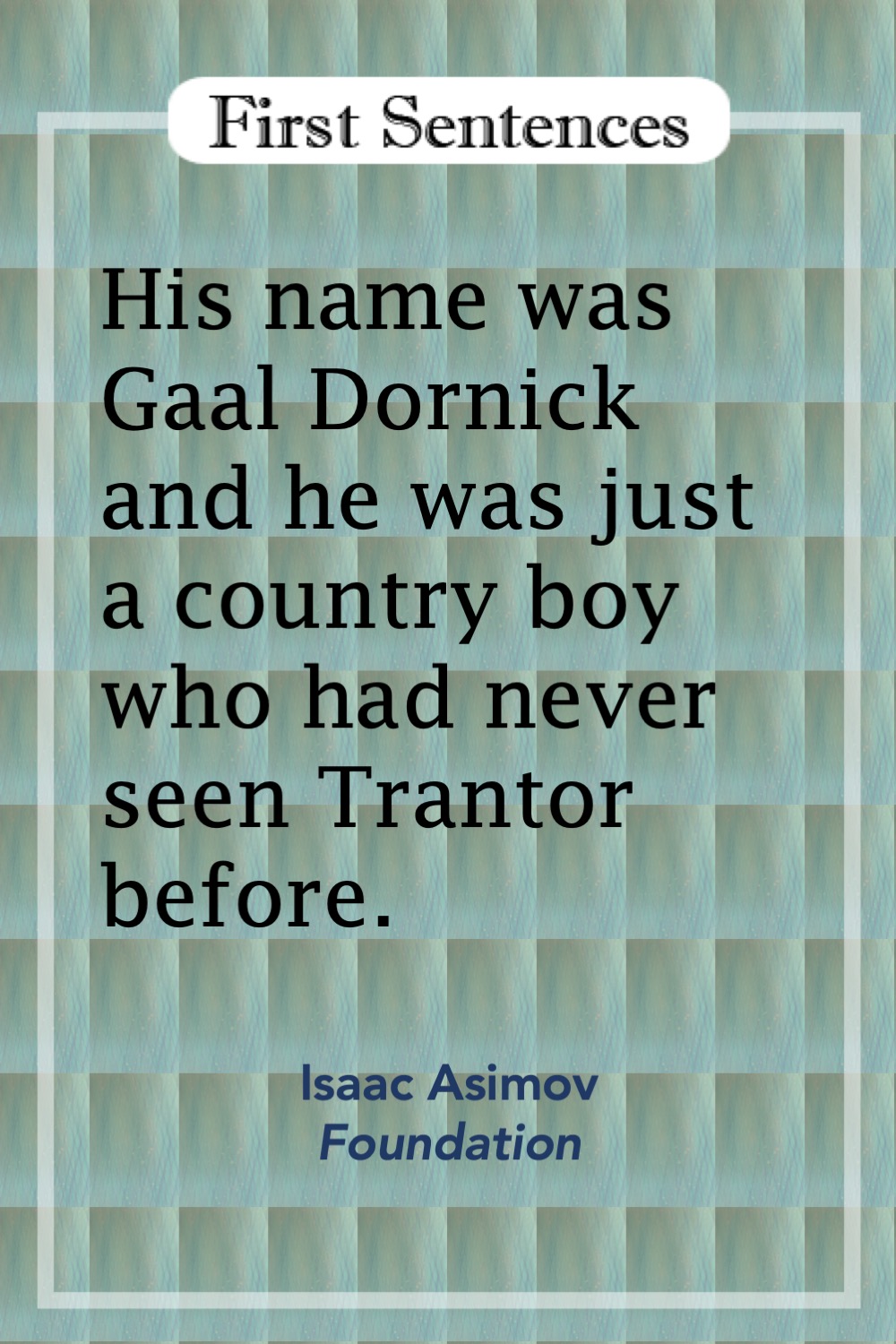
Foundation was published in 1951. Its first sentence shows a young man taking that same trip from country to city that I would: "His name was Gaal Dornick and he was just a country boy who had never seen Trantor before." We don't know where Trantor is. But it is a place a "country boy" hasn't seen: very likely a city.
Who is Gaal Dornick? A "country boy" with an unusual name. He's someone young, untraveled, and in an entirely new place – which means he can see Trantor at the same time as we do. He will have the same kinds of questions about it that we would if we were there. His name and the unfamiliarity of "Trantor" suggest that we are in a different world. Yet someone fresh to that world will help us enter it by puzzling his way through it as we would have to.
The young character suggests we may see Gaal grow up; his arrival in a new place promises the pleasures of a travelogue. Gaal will need to find his way around, a source of conflict. This first sentence begins to open a world, a character, and a conflict for the story in eighteen simple words.
As a small town girl myself, is it any wonder I wanted to see what happened next?
I like the rhythm of the sentence, too. Try reading it aloud.
Graphic design by Ken Silbert
Monday, December 21, 2020
The Cracked Bell
Monday, December 14, 2020
I Was Told It Would Get Easier
What does it mean to mix a metaphor? It's when a writer begins by describing something as one thing and ends by describing it as another. In this case, Waxman first compares her day to a bull – that is what we "take ... by the horns" and ends by comparing it to a scarf. The result is that we imagine the narrator throwing a bull over her shoulder, horns to either side of her neck, legs and torso draping down her back.
Writers can break rules. In fact, when they want the effect that breaking the rule brings, breaking them is good writing. With careful word choices, Waxman has made her sentence clear, despite the mixed metaphor. She intended the absurdity of a bull draped over her narrator's shoulder.
Absurdity is one form of humor. Waxman may also have meant this sentence to be funny. Notice that the central mixed metaphor is softened by phrases before and after it. Look at what happens if we trim this sentence down to the absurdity: "I took the day by the horns and threw it over my shoulder like a scarf." To me at least, that is funnier. Taste in humor varies widely. Waxman's original sentence might tickle some readers more than the condensed version. I am more likely to laugh when the sentence is briefer and ends on the word that makes the unexpected contrast.
So what happens when we add back in the words I took out? The first phrase, "I left the house this morning, determined to..." places the action in a specific time and place: "this morning," leaving "the house." Now her action is unusual, perhaps something she has only tried once or a change from what happens in other places and other times. "Determined to" is self-conscious. The narrator is observing her own emotions. The words of this phrase are bland, diluting the vivid image of the bull-scarf to come.
The final phrase, "if necessary," casts doubt on whether everything before it will happen. The narrator is leaving herself an out. She might not take the day by the horns. She might decide she doesn't need to.
The final effect is one of anxiety. The narrator wants to do something bold, and she has hedged it on both sides as uncommon and unlikely.
The self-observing, somewhat funny, somewhat anxious female narrator places this book in the company of books by Helen Fielding and Sophie Kinsella. This sentence suggests that if you like the company of women like the narrator, you will enjoy spending more time with her. Many readers can empathize with feeling a little anxious, and like to spend time with people with a sense of humor. So the sentence calls to that audience specifically.
Graphic design by Ken Silbert
Monday, December 07, 2020
The Sign of Four
In other words, Sir Arthur Conan Doyle's stories about Sherlock Holmes are canon – or if not part of some universal canon, certainly an ancestor to wide swaths of stories about detectives and companions, intelligent men with abrasive personalities, and applying insight instead of force to resolve crimes.
When I went to check for first sentences, I found the stories drew me in. The writing holds up.
What clues does this first sentence hold to the lasting appeal of Sherlock Holmes?
The Sign of the Four is the second story Conan Doyle wrote about Sherlock Holmes. So the name Sherlock Holmes would have attracted readers who enjoyed the first story, but would not yet have had the widespread recognition it has now. "Sherlock Holmes" is a distinctive name. Neither the first name nor the last name are common. Together, they are very likely to mean one specific person. The name sticks in the mind better than a more common name might, and by its oddness, suggests the character will also be particular.
There are other very specific details: "mantlepiece" – the shelf above a fireplace, "hypodermic syringe" – at the time, a fairly new piece of medical technology, "morocco case" – a fitted container covered in a specific style of leather. These details are like the clues that the mysteries will hinge on. They are precise, meaningful, and observant.
At the time of the book, no law forbade a private citizen from having a syringe and a bottle of narcotic. Some people had developed addictions. In the following sentences, John Watson, a doctor, worries about Holmes' use of the drug.
Reaching for a bottle and syringe, then, like now, showed that Sherlock Holmes had a flaw. He was a closely observed character with both outstanding skills and significant weakness.
I like the opposition here between "hypodermic syringe" and "neat morocco case." The syringe is dangerous, novel, and piercing. The case is tidy, traditional, made from animal skin, and enclosing. The tension between these items reflects the concern that the character who has them will harm himself. Wanting to see what happens creates a subtle hook. If I know the name "Sherlock Holmes," this sentence is also a promise that I will learn more about a character I like, and that there will be more close observations and exact details.
This sentence works on many levels.
Background leather texture by Felipe Santana on Unsplash, graphic elements by Ken Silbert
Monday, November 30, 2020
Empire of Wild
The first two words take on a less common meaning already. "Old medicine" on its own might mean "an expired bottle of Tylenol." The next words, "has a way" treats the medicine like a person, something that has habits and will of its own. This medicine is also capable of haunting the land – that gives it a spirit, like a ghost. Medicine that has will and spirit is powerful and shamanic. This is medicine in the sense of Native American knowledge. This word doesn't belong to me. Dimaline uses it to begin placing us in her world.
Look at the phrases "being remembered" and "was laid." They both imply that someone remembered and someone laid the medicine. But while the medicine directly "has a way... of haunting" the people who remember and lay are pushed out of sight by the passive verb tenses. It feels as if the medicine has more control than the people do.
These are words in the sentence that, rightly or wrongly (and Dimaline will ask us to consider this in the novel) we associate with indigenous people on this continent: old, medicine, remember, land. Each one in the sentence strengthens our association. Words sometimes work by bringing in connotations, drip by drip, until they add up to an impression, like spots of color added to a Monet painting. Artists can create effects from a single splash of an intense color, or from several points of less intense pigments. A writer also can choose several slightly associated words – rather than one strongly associated word – from a field to give readers an association with the field, creating a blatant or subtle effect.
I see another set of words in this sentence: old, haunting, laid. These words draw from the language we use for cemeteries, ghosts, and horror. The sentence would point even more to horror if "laid" was changed to "buried." We use "buried" for the dead and "laid" for the inanimate and the sleeping. Do you taste how "laid" is a little softer and more ambiguous than "buried?" "Laid" also gives the alliteration with "land," which might be worth more to the sentence.
Both "haunting" and "medicine" are strong, specific words. With the rest of the sentence, they build both place and sense of foreboding. This sentence is a hook.
Monday, November 23, 2020
Two Roads
Let's start with "us": two letters that mean the narrator is traveling with at least one other person. Travel in company tests and refines relationships. Having someone with you – who can argue, laugh, watch your back, suggest detours, and more – makes a trip a richer experience.
Next, there's "red." Red is the most attention-grabbing of colors. Red roads are far less common than black roads. "Red" is another short word that sets this road apart. The sound of "red road" is lovely as well. The words have both their first and last consonants in common, a pleasant close match of sounds. And both words are strong, accented syllables, making the two of them a pair of strong drumbeats.
"Stretches out before us" calls us forward onto the road. There's room to move ahead. Since animals stretch, that verb makes it almost as though the road is placing itself for our attention.
The red road stretching out before us is also easy to visualize. All these words are well-tied to the physical world. We can see red, roads, and stretches, and place them before us in our mind's eye.
With "a long ribbon of light," the sentence turns a little more abstract. It repeats the idea of "long" that was in "stretches out" and the flat, parallel edges of a road are like the shape of a "ribbon." But "light" is not quite a match for "red." Light is more often white than red. So "light" doesn't simply repeat what the first of the sentence described in other words. It adds to or changes the picture.
Light is also attractive. So the final word of the sentence adds another pull to move ahead on that road.
I like the structure of this sentence. The rhythm is varied enough to reward reading aloud. The many Rs bring the sound together. And while many authors avoid repetition, the way the words after the comma echo the meaning of the words before the comma, and then add a twist, is reassuring without becoming stale.
By the end of the book, I knew much more about who "us" was and what the roads they traveled would be, and I was happy to have taken that trip with them.
Monday, November 16, 2020
The Four Profound Weaves
A novel is a world. Even when it takes place in current times, in the country where the reader lives, a novel opens a new perspective. For a while, a reader shares a narrator's vision, a narrator's priorities, a narrator's moment-by-moment passage through their experience. The change may be as subtle as moving a camera two inches or as vast as awakening to a pterodactyl's cry.
In either case, the world of the novel is not the world of the reader, until they begin to read. So we readers need a doorway or a bridge to reach the world of a narrator.
I love this opening sentence from R.B. Lemberg. It's not a hook – it doesn't strain with danger. It's not a promise. There's no weight on where the story goes next. The word "alone" suggests that "I" may stop being alone – or may not. The word "in" holds the possibility of "out" but doesn't coerce that next step. There's no giveaway to the genre of the story – an old goatskin tent could be historical or contemporary, realistic or fantastic.
I have a third type of first sentence I consider: the seduction. First sentences are seductions when they promise pleasure. I started looking at this sentence, and I wasn't sure what pleasure it promised. Would I need to make a new category? "I sat alone in my old goatskin tent."
No, as I looked longer, I saw the pleasures here.
First, there's the pleasure of travel. I have never been in an old goatskin tent. Here's a chance to see what that is like. The precise detail – "old goatskin tent" – is rich and concrete. The narrator who sees that detail can bring me to their world well enough for me to see it, too.
Then, there's the pleasure of autonomy. Whoever this narrator is, they have the independence to sit alone in their own tent. This "I" will control their own destiny, at least to that extent. I like spending time with people who make their own choices.
The pleasure of clarity comes next. This sentence has no ambiguous or wasted words.
The last pleasure I'll note is the pleasure of rhythm. I read the sentence with accents on the syllables I'll follow with apostrophes: I sat' alone' in my old' goat'skin' tent'. Would you drop the accent on skin? That creates a very steady rhythm, as "in my" rush together. But "skin" is so visceral, I find myself slowing so I can make the last three syllables all strong, hard raps. Either way, the rhythm adds music to the sentence.
This sentence drew me when I first read it in a sample. This morning, with the whole book in hand, I smiled at the sentence again and read the entire short book before I came to write about it.
Graphic Frame by Ken Silbert
Thursday, November 12, 2020
Trail of Lightning
How about the other words here? "The" suggests this monster is the only or most consequential one in the area. "Has" is present tense, which brings the story into the moment. Look at the difference a single letter makes between these two versions: "The monster has been here." "The monster had been here." "Has" is closer and more urgent. Also, because most of the stories we see in the present tense are also told by "I" – that is, in first person – "has" suggests that the narrator will be telling this tale directly. "Been" is neutral. Like all forms of the verb to be, it links other words with minimal shading of its own. The monster did not stand or rest or shred or kill or act in any more distinct way here. It existed here – which is worrisome enough. Finally, "here" is another word that brings the action of the story close to us. In this location, where we are, there was recently a monster. The monster might not have gone very far.
A first sentence with tension or suspense is a hook. "The monster has been here" is definitely a hook. A first sentence can also be a promise – a sentence that creates an expectation about a story that the rest of the book needs to fulfill. With the word "monster" and the implied narrator, we have two characters. Monsters are usually villains and protagonists who tell their own stories are usually heroes. A villain plus a hero sets up a conflict. So this sentence suggests that the narrator and the monster will eventually face each other and fight. That is a promise.
The word "monster" also suggests the genre of the story. Monsters appear in fantasy and horror, and can only belong to realistic fiction as metaphors. This sentence is blunt and straight-forward. There's nothing to suggest that this is a figurative monster. While the monster could still turn out to be, for example, an abusive father, an author who wanted to use "monster" in that way would usually give a clue in voice or other details. Instead, Roanhorse has surrounded the fantastic detail with ordinary words, a strategy used by authors like Stephen King to add reality to supernatural situations.
I've read and enjoyed the entire book. The monster is literal and powerful.
Could any five words have this much impact? No. I make a habit of choosing the first sentences that interest me. Only a tiny percentage of books start with a sentence that hold my interest enough for me to write about them, and very few of those are this short. Rebecca Roanhorse has written an excellent hook and promise.
Monday, November 09, 2020
Solar Flares
That's not to say I am coming to the sentence with no preconceptions! In September of 2019, I marched, and "I hear the voice of my great-grandmother" was a line in one of our chants. Even though Hogan's sentence dates from 1995, I'm meeting it now, so I hear it flavored with the joint action and care for the world I associated with the march.
This is the fate of anyone who speaks a language. Every sentence carries echoes of similar sentences, of how the words have been used before, and who has used them. If it were not so, the words wouldn't carry meaning from one person to another.
Within the sentence itself, we have two characters: "I" and "my great-grandmother, Agnes." There's no particular conflict. The only verb, "hear" is neutral, nor are voices or great-grandmothers particularly threatening. Perhaps we'd feel a shiver if this seemed to be a ghost story, but there are no words to suggest a worrying or uncanny situation. "Hear" may simply refer to remembering.
The most precise word is the name "Agnes." Agnes is a name once more popular than it is now. It seems a match to a great-grandmother.
The most unusual part of the sentence is its location in time. "Hear" is in present tense. "Sometimes now" is complex. "Now" means currently, and often implies a very short period. "Sometimes" means only off and on, which requires a longer period so that the hearing has time to both happen and not happen. Together, "sometimes now" seems to mean in the current period but not before ("now") I intermittently ("sometimes") hear my great-grandmother's voice. The narrator uses two words to define the time, yet each of them has loose boundaries. The result is a slippery sense of when the sentence is happening – "now" but extending some amount into the past, "now" but maybe not this precise moment, only "sometimes."
"Great-grandmother" extends the timeline into the past. A great-grandmother must have existed well before her great-grandchild. The voice of the great-grandmother comes from the past, into the present, blurring the time mark even more. Although "hear" is simple and present, the words "sometimes" and "great-grandmother" stretch the current "now" farther and farther into the past, suspending "now" over a long period, like a vision of eternity.
Hogan's sentence doesn't describe a danger. Instead, it shows memory and heritage. It promises that the narrator will grapple with the influence of the great-grandmother's voice – an appealing offer to readers who have their own family history to understand.
Monday, November 02, 2020
Silver Sparrow
The speaker uses formal language to tell us of this crime. It's a curiously detached way to speak of it. "My father" is a distant way to speak of that relationship. Calling him by his full name is also unusually precise. That name, "James Witherspoon," has an English flavor, which we often read as more stiff, and also sets this in a legal context where bigamy is a crime. Then "bigamist" is the legal term, also cool and indirect.
The two commas create pauses that add to the impression of speaking rationally and reflectively. The narrator's father has committed a crime – a shocking crime within that culture. But the narrator also speaks of this as distantly as possible.
From this one sentence, we expect the story to unfold the consequences of this crime through close observation and muted feelings.
How much differently would you expect the story to go if the first line was, "My pa Jimmy has two wives?" Would you be more or less intrigued if there were more emotionally laden words added to the sentence, such as, "My dad, James, is a lying, two-timing, worthless oath-breaker?"
As it is, the two characters in the sentence – the narrator and the father – stand apart from each other, and the narrator looks at the father more to think about the situation than to feel it, at least on the surface. The crime in this sentence creates tension. The tone of the sentence suggests how the story will approach that problem.
The more a reader likes that voice, the more drawn they will be to continuing the story. The sentence promises to think about a difficult situation.
Graphic design by Ken Silbert
Thursday, October 29, 2020
The Killing Dance
There's an intriguing contrast in the first four words. "The most beautiful" anything attracts desire. We compete to spend time with beautiful people and own beautiful art, furnishings, and homes, and to spend time in beautiful locations. On the other hand, we are repelled by corpses. The stench of decay creates an automatic reaction of disgust. We arrange our lives and deaths so that we see as little as possible of corpses. When we do see someone deceased, it is most often in the distanced, ritualized contexts of a hospital or funeral.
So "the most beautiful corpse" establishes a fast push-pull sensation in a small number of words.
The next phrase, "I'd ever seen" also accomplishes a lot in a few words. "I" brings in a character, the narrator. "Ever" intensifies the claim of beauty – it is not just the most beautiful of the moment, it is the most beautiful of all time. "I'd ever seen" could raise a question: How many corpses has the narrator seen, and were they attractive? Where some narrators would be slyly suggesting that this is the only corpse they've seen, the informal "I'd" and the short words create a matter-of-fact tone that suggest this is a direct statement instead of an ironic one. It seems likely that the narrator has seen some corpses, and isn't that surprised to see another.
The final words of the sentence, "was sitting behind my desk," reinforce the even tone by describing an everyday situation in common words. To sit behind a desk is ordinary. There are no descriptive flourishes about what kind of desk, or the way of sitting. The narrator has seen something surprising – a beautiful corpse – and rather than becoming emotional, goes on to talk about common situations in neutral words.
In short, the narrator keeps their cool when faced with a beautiful corpse, betraying neither attraction nor disgust in the remaining words.
The beautiful, unexpected person in an office is a situation that begins many private investigator stories. This sentence picks up that heritage, with the even-tempered narrator and the troublesome client ready to start the action.
There's also one type of corpse that is most known for its beauty: the vampire. To call a vampire "beautiful" is to admit an attraction; to call a vampire a "corpse" is to push it away. We don't yet know, from this sentence alone, that the narrator is facing a vampire. We do know the narrator has mixed feelings. Thus this one sentence starts both an outer conflict, between the narrator and the problem created by the corpse, and an inner conflict within the narrator's own feelings.
Laurell K. Hamilton has wound up the propulsion of her story in one seemingly simple sentence. This is excellent writing.
Graphic design by Ken Silbert
Monday, October 26, 2020
Frankenstein
Mary Shelley wrote Frankenstein in 1818. The sentence is long, as was common at that time. It also features strong, emotionally laden words, a feature of Romantic style, which was dominant in the early 19th century. These are the words that create the strongest emotional response: rejoice, disaster, evil, forebodings. The last three are all negative, which outweighs the lone positive word in the list: rejoice.
The sentence implies two people, one who is speaking, and "you," one who hears or reads the words. The narrator is reassuring "you" that their evil forebodings have not come true. We have no place, no concrete details – there is nothing here that can be seen, heard, touched, tasted, or smelled. As far as time goes, we only know that an enterprise has commenced.
"Commenced" means that the enterprise is begun. It does not mean that it has completed. So it is not as reassuring as the narrator hopes to say that "no disaster has accompanied the commencement of an enterprise." Will disaster accompany the middle of the enterprise? The completion of it? Also, "disaster" means a huge and enveloping crisis – to say that there has been "no disaster" still leaves open the possibility of many smaller, and still quite serious, problems.
Both the first and last words of the sentence project the future. The first words, "you will rejoice" are what the narrator expects his later words to accomplish. But as we have seen, the middle words only weakly argue for that outcome. The final words are what "you" projected into the future: "evil forebodings." "You" had a feeling that the enterprise would go badly. "Evil" here can carry two senses. It could intensify the negative strength of the forebodings, or it could mean that the forebodings were themselves a danger. In expressive writing, all the possible meanings can influence how readers feel about the sentence. So both meanings have an effect and both may reflect the author's intentions.
With only "disaster" avoided, and only at the "commencement," and with "evil forebodings" placed in the strongest position, the sentence creates tension rather than reassurance. The dangerous future still looks more likely than that "you will rejoice."
One other note – this is the kind of sentence that might start a letter. "You will rejoice to hear" fits very well with "when you receive this letter." In fact, the headings in Frankenstein say this is Letter One. When there were fewer novels, to tell a tale in the form of letters may have been a familiar way to approach the writing. The term for book-length fiction written in letters is an "epistolary novel." Dracula also takes this form.
Graphic design by Ken Silbert
Thursday, October 22, 2020
Gideon the Ninth
First we have a time stamp: "In the myriadic year of our Lord." "Myriad" is a word that means either "very many" generally or "ten thousand" specifically. "Year of our Lord," as a translation of the Latin phrase "anno domini" recalls medieval times and monasteries. Then, between the dashes, the meaning takes a twist. "Ten thousand" clarifies "myriadic." "King Undying" is a little off to describe the "our Lord" that "year of our Lord" refers to in our world and "kindly Prince of Death!" doesn't match in either tone or terms. This time is disjointed from ours.
I particularly like "kindly Prince of Death!" The Greeks called the Furies the Kindly Ones to mollify them, as the Celts called the fae the "fair folk" to soften their attention. So "kindly" here balances on an edge – is this "Prince of Death" truly kind, or is he capricious and powerful enough that those who speak of him try to soothe him? "King Undying" and "Prince of Death" places him as someone who does not die himself but has dominion over those who do – or can cause death. "The kindly Prince of Death" has a strict alternation of accented and unstressed syllables, creating a strong, march-like rhythm. To put the final gloss on the phrase, the exclamation point adds extra emphasis to the word "Death" – strengthening the rhythm and treating "Prince of Death" as something to be excited about. Why would someone be cheerily enthusiastic about death or its ruler?
Now we have a time that is not our time and a world that is not our world, since it has the King Undying in it. Some sentences would be content to accomplish that much and raise curiosity about the narrator's attitude toward death. This one has half its words still to go.
Tamsyn Muir next places a person in this time and world. The name "Gideon Nav" is a close match to our naming conventions but not a name we'd expect in our world. We learn of three specific bundles she grabs, "her sword, her shoes, and her dirty magazines" which show her priorities. The sword suggests she is a fighter, with an archaic weapon. The shoes are a fairly common item to pack. The dirty magazines are a surprise, placed in the strong final position in the list. The previous allusions to monks and premodern weapons don't match the modern, popular culture of "dirty magazines." By the time we had mass color printing, we'd stopped using swords and saying "the year of our Lord." Plus, we often tend to romanticize knights and ladies and thus imagine them too noble for smut.
Finally, Gideon "escaped from the House of the Ninth." "House of the Ninth" is a return to the aristocratic flavor of "sword" and "our Lord" (and those words added an internal rhyme to the sentence). "Escaped" is a vivid word that creates excitement. It means she is running from danger. What is the danger? Will her escape succeed?
At forty words, this is a long sentence for a contemporary opener. That length contributes to an antique feel. The fusion of feudal words with a pop of current culture and a date that must be in the future shows that this world won't color inside expected lines. That's fresh. I'm curious about Gideon Nav, her world, and her situation, and ready to see a new story. Muir has used her extra words well.
Graphic design by Ken Silbert
Monday, October 19, 2020
Adulthood Rites
When writing science fiction or fantasy, how important is it that the first sentence signal that we are not in the current world?
Monday, October 12, 2020
The Atlas of Love
Monday, October 05, 2020
Bastard out of Carolina
She calls out two names: Bone and Ruth Anne. Bone is an unusual name, especially for a child. It's a little unsettling, recalling skeletons and mortality. What would be your first vision of someone named Bone? Perhaps a man known for violence that left stark white showing through flesh, or a widow, wrinkled and shrunken so that her thinness leaves the underlying structure barely covered? Surely not a preschool girl. We toss away bones, and at least hope to see children guarded and precious.
Ruth Anne, with the two Biblical names and a middle name of a single syllable included, belongs to Southern tradition in the United States. Without naming a location, Allison has already implied one.
Names are personal and integral. They form part of our identity – and reflect our relationships with the people around us. Bone is the name the narrator has "been called" – someone else has given it to her and pushed that identity on her – "all my life" – as far back as she can remember.
"But" – there's a word to create an opposition in a single syllable. "All my life, but" – puts an end to what has happened so far. This is it. She is making a change. "My name's Ruth Anne," asserts a new identity. Now she will carry an appellation that marks her female and as worthy of extra syllables and formality as the other daughters around her. Now she'll go by something that sounds like the name of a person instead of an object.
This is very elegant word crafting, all in words of one syllable and in a simple structure. In one sentence, the narrator is asserting her right to be a person and her conflict with those who called her otherwise. We have voice, person, desire, implied location, and true conflict between the narrator and her society wrapped in a single sentence. Although the short words and short sentence may appear artless, they include many of the strongest elements for an effective first sentence.
Graphic design by Ken Silbert
Monday, September 28, 2020
Goldfish
What do we know about Marlowe from the first sentence of "Goldfish?" First, he works. Otherwise, there would be no need to call out "I wasn't doing any work that day." He's not a student, retired, or wealthy – he needs to earn a living. Second, he is an observant, dry, wise-cracker. He paid attention to notice that he was dangling his foot, and he pushed the absurd idea that he might be behind on that activity.
Chandler has used the comic tool of placing a surprising word at the end of a sentence here. Because this is in Marlowe's voice ("I"), the character has used that tool as well as the author using it.
The language of the sentence is close to speech. The words are short and common – the longest and least common is foot-dangling, and "dangling" is specific without being pretentious. Marlowe comes across as an attentive but casual working guy, talking directly to us. He speaks clearly and with some humor. The appeal of spending time with someone like that is one of the lures to read on.
Marlowe also hints that something is about to happen; he tells us that he wasn't working at that point – which implies that work is about to arrive.
I checked all the first sentences in Chandler's Collected Stories. He most often uses his first sentence to invoke a person or a setting. Problems are more muted. He uses vivid, specific details and strong voice to draw readers in rather than immediate danger.
It's enough. Raymond Chandler remains respected as a mystery writer and a stylist more than sixty years after his death.
Graphic design by Ken Silbert
Monday, September 21, 2020
Painless Poker
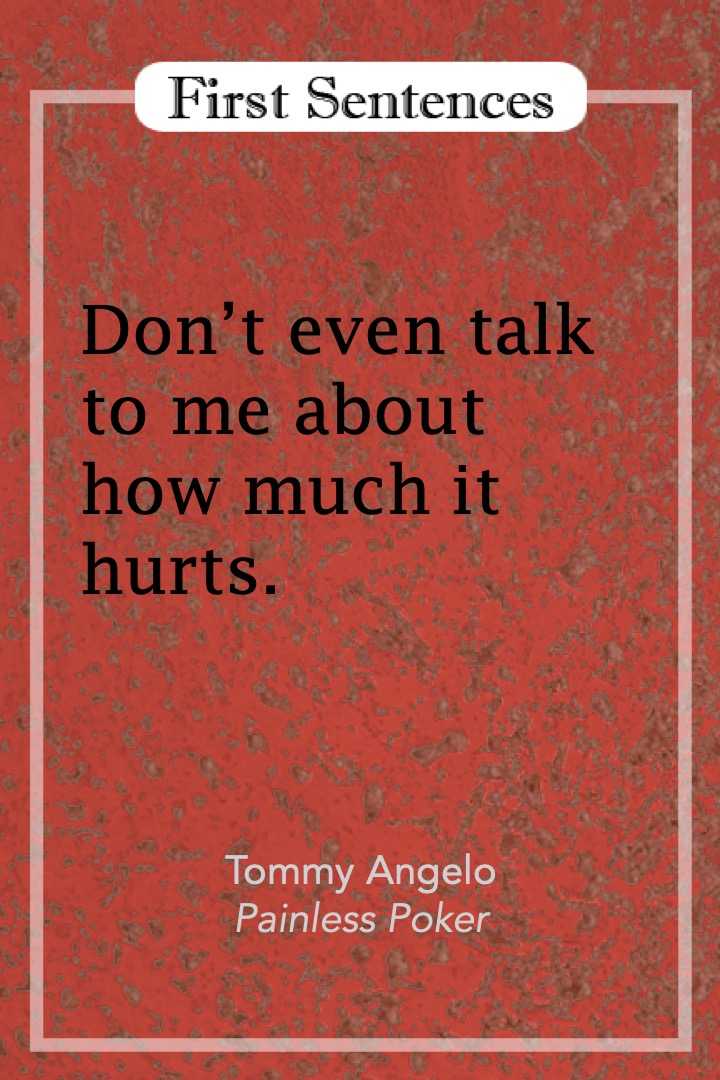
Painless Poker's first sentence is direct. It uses short, informal words, as if the author was speaking in person to the reader. "Don't even" has attitude – a pushy, triggered edge – these are the words someone would use who was tired of the same complaints heard over and over again. The author presses us not to speak to him – even though we actually can't. That creates an instant feeling of being in the conversation. We are close – there is no polite distance or protective frame between us and the author.
And what would we talk about if we could? "How much it hurts." The subject is pain. Pain is the most intense evidence of a problem, personal, present, and physical. The sentence implies that you have pain, and the author knows it. That's the hook – you have pain. There are two people who have problems here – you with your pain and the author, who knows it, but doesn't want to hear about it.
There is also a promise. The direct language implies that the author will tell you the truth, and the fact that he knows you have pain implies that he sees you, even if he doesn't want to hear about you. So the promise is that you will hear truth that applies to you.
This is a compelling sentence. I tried to talk Tommy out of it. It was too rude, I thought, to be a reader's first encounter with the book, and it might leave the reader thinking Tommy didn't care. The sentence had come to him after months of engaging with the book, and he knew it was right, so after discussion, he kept it. That's also part of the editing process – because I'd tested his attachment to it, he was able to know that it was right for him. And because I work to "I suggest, you choose," once we'd had the conversation, I supported it from then on.
Painless Poker is a brash book. It's a genre-breaking combination of poker instruction, autobiography, and fiction. The first sentence breaks convention as well. So it is a good reflection of the book to follow.
"Don't even talk to me about how much it hurts" is bold, intimate, and divisive. It starts Painless Poker off with a jolt of connection and drama and perfectly suits the rest of the book.
So I'll give Tommy's subconscious top credit for crafting a capital first sentence.
Graphic design by Ken Silbert
Thursday, September 17, 2020
Love Lettering