Monday, May 24, 2021

The Heiress Effect


The first sentence of Courtney Milan's novel, The Heiress Effect, is: "Most of the numbers that Miss Jane Victoria Fairfield had encountered in her life had proven harmless." 

This sentence introduces us to one character, the precisely named "Miss Jane Victoria Fairfield." Her name already speaks of a particular time and situation. "Miss" means unmarried, and probably from a past time and a social group where people address each other formally. "Jane" is a common name, simple. As a first name, it suggests a woman without pretension – unlike "Victoria" which is long, flowery, and invokes Queen Victoria. The middle name suggests a much more powerful and high status person than the first name – as if the plain first name is a cover for a more assertive center. "Fairfield" sounds simple, again – the combination of two common, pleasant words, easily pronounced and both starting with "f." 

If you imagine a woman named "Jane Fairfield" and another named "Miss Jane Victoria Fairfield," how do they differ? The two extra words show Courtney Milan's attention to detail, and they change my view of the woman described significantly. 

There are other signs of attention to detail in this sentence. The two uses of "had" show careful ordering of events. "In her life" is almost too precise – where else, after all, might Miss Fairfield have encountered anything? "In her life" could be omitted – but leaving it in, if we read this as a close reflection of how Miss Fairfield thinks, shows her as fussy and particular. If we read it as what to expect from the narrative to come, it tells us to count on clarity and fine focus. "Numbers" and "had proven" are words from science or mathematics – they also suggest careful, rigorous, detailed work. 

When it comes to creating tension, the first and last words here do a lot of the work. "Most" implies "but not all" – put "most" together with "harmless" and we hear that while most are harmless, some are harmful. What harm has come to Miss Jane Victoria Fairfield? 

And what is that harm due to? "Numbers." Here is an intriguing mismatch of expectations. It's not numbers that we expect to do harm. How can such abstract concepts hurt someone? Nor are "numbers" the problem we expect a "Miss Jane Victoria Fairfield" to grapple with. "Suitors," perhaps, would have been the term that fit with that name. 

The melding of two unexpected fields – an upper class woman of a previous time and mathematics – adds some mystery to the sentence. If all the words had come from only one of these fields, the story would have tighter bounds. Instead, with at least two fields in play, the story begins with a bit more surprise and complexity. 

This sentence is a hook, because it creates tension with "most" and "harmless." (Those are two words that remind me of Douglas Adams when combined, although his exact phrase is "mostly harmless." However, separated as they are, and without more pointers, I wouldn't call this a reference to him.) It is also a promise, because the name "Miss Jane Victoria Fairfield" is exactly the kind of name found in historical romance, and because the careful words suggest that if I like complexity and attention to detail, I will like this story. 

Did that sentence lead me to read on, and did the book fulfill its promise of an experience I'd enjoy? Yes, reader, they did. 

Background and frame by Ken Silbert

Monday, May 17, 2021

This Close to Okay


This Close to Okay gathered many recommendations. Leesa Cross-Smith starts her fourth book with this sentence: "Tallie saw him drop his backpack and climb over the metal railing, the bridge."

Here we have two characters, "Tallie" and "him." We have a life and death situation: When someone climbs over the railing of a bridge, they make suicide possible, as well as fatal accidents. Tallie has a choice to make – intervene or leave him to his fate? With suspense, tension, and high stakes, this sentence has all the elements of a hook. 

Yet I find it fits my "seduction" category even better. 

A first sentence that works as a seduction draws the reader in with beauty. There's a strong rhythm to this sentence. I read the stresses as almost alternating, like this: Tall'ie saw' him drop' his back'pack' and climb' ov'er the met'al rail'ing, the bridge'. The even rhythm of the first seven syllables breaks just as he begins to climb – when he crosses out of safety. "Metal railing" returns to that rhythm – the even pace matching the safety feature. Then, the only comma makes a gap, and the rhythm turns upside down, creating uneasiness and extra emphasis on the word "bridge" – even stronger than the usual weight on a final word. 

The comma marks a hitch in more than one way. We pause a little when we read a comma. Did Tallie's breath also pause there? And there is a break in the wording. We expect extra words to fall between "the metal railing" and "the bridge." Strict grammar would add a preposition there to show how the words are connected, such as "the metal railing on the bridge," or "the metal railing of the bridge," or "the metal railing at the edge of the bridge." Those words are gone.

The missing words leave "the bridge" on its own, a little detached from the sentence. They create some ambiguity – now we have less guidance as to how the railing relates to the bridge. Do the words "the bridge" redefine "metal railing" so that the railing is the bridge? Is "the bridge" an exclamation? Or is "the bridge" like the state and "the metal railing" like the city, so that "the metal railing, the bridge" is like "North Tonawanda, New York?" 

To leave out the small, dull words and create multiple possible meanings is a poetic device. So is paying attention to rhythm. This sentence has a kind of linguistic intensity that draws me in to savor the words, as much as the tension of the situation does. 

Both tension and linguistic intensity continue through the entire book. The first sentence proved a good taste of the story to come. 

Graphic design by Ken Silbert


Monday, May 10, 2021

Autonomous


Annalee Newitz' first book, Autonomous, was nominated for multiple awards. The first sentence is a classic hook: "The student wouldn't stop doing her homework, and it was going to kill her." 

Newitz presents a situation and raises the stakes. "It was going to kill her" means that life is on the line. We have a crisis – can anyone save the student's life? 

We have one character, the student. As a student, she is likely young. We also know, by her pronoun, that she is female. Both these character traits mark members of society we often feel more protective of, which raises the stakes again. 

What else do we know about her? She is doing homework. In other words, she is following the rules, which are part of a system we hope will keep our children safe. 

Instead, "homework" is the "it" that "is going to kill her." A normal activity is somehow placing her in danger. 

It's another surprise that she "wouldn't stop doing her homework." We expect students to resist doing homework, to put it off, or to rush to finish it so that they can go on to something else. How has it happened that this student won't stop? That's a mystery. 

This sentence grabs the reader by creating tension and suspense. Something is wrong when a student won't stop doing homework and the situation is even more critical when the homework threatens the student's life. This sentence is an archetypal hook. 

When I started writing about first sentences, I expected to find many hooks. As I went on, I found that a good proportion of the sentences that drew me in offered other enticements. In my mind, I now have three categories, which sometimes overlap. A hook draws me in with immediate conflict. A promise invokes other stories and suggests that if I liked those, I will like this one. A seduction draws me in with its sheer beauty. It's my personal division of a wide world of first sentences. Time will tell whether I still like these categories after another fifty sentences.

Photo by Joshua Hoehne on Unsplash

Graphic elements by Ken Silbert


Monday, May 03, 2021

Lovecraft Country


Matt Ruff's novel, Lovecraft Country, came out in 2016 and the HBO series based on it arrived in 2020. I had read one of Ruff's previous novels and liked it, so I picked up  Lovecraft Country around 2017 and liked it even more. 

It was right up my alley. There's a literary reference in each of the title and first sentence. "Lovecraft" refers to early twentieth century horror author H. P. Lovecraft. "Atticus" is a name most likely to call to mind Atticus Finch, the noble lawyer in To Kill a Mockingbird. These two references bring in the ideas of horror and justice. 

How many times have we seen someone make it almost to safety before something happens? Enough times so that when we see "was almost home" it brings a sense of dread. "Almost home" is not yet home, not yet safe. 

What happens when Atticus is almost home? "The state trooper pulled him over." For some of us, this is a concerning but not life-threatening event; for others, including people of color, this is much more tense and dangerous, possibly lethal. How much danger is Atticus in? Is he Black? 

Some elements of the sentence suggest he might be. The name Atticus isn't drawn from the most common pool of names for White males. Troopers are more likely to pull over people of color. And we know, as readers, that a big danger is more likely to start a story than a small one. 

This is a literary sentence, not because it is flowery or obtuse, but because it connects to other works that add to its resonance. Reminding us of To Kill a Mockingbird sets a mood, even as a man stopped by a trooper sets up a character and a problem. It's elegant writing to offer tension for any reader and even more to readers who hear the echoes of other works. 

Photo by Pat Whelen on Unsplash
Graphic elements by Ken Silbert

Monday, April 26, 2021

Night School


Night School is the twenty-first book in the Jack Reacher series by Lee Child. Its cover proclaims it a #1 New York Times Bestseller, and the publisher's website calls it the eleventh straight global bestseller in the series. Lee Child's books have gained a significant audience. 

The first sentence of Night School has a lovely parallel structure: "In the morning they gave Reacher a medal, and in the afternoon they sent him back to school." "They" do one thing to Reacher in the morning, and do another to him in the afternoon. 

We don't yet know who "they" are – some group of people who have authority over the named character, Reacher. We might know who Reacher is. By the twenty-first book in an extremely popular series, people who pick up this book may have good feelings about reading more about the series' main character. This is a series dividend: Readers become invested in following the character. Those readers may have some opinions about what Reacher deserves. 

What's interesting here is that the two actions "they" do to Reacher are oddly different. Usually, someone gives a medal to a hero, someone experienced and accomplished. Usually, someone sends another person to school when that person is lacking in experience or judgment or knowledge. So which is it? Do "they" admire Reacher and want to reward him or disapprove of Reacher and want to retrain him? In this sentence, it is both, and that sets up a mystery and some tension. 

Placing "school" in the strong, final position lets the sentence end on a surprise. Until the word school, they could have sent Reacher somewhere that would have expressed more approval: back to work, back to his hotel, to the parade, home, to the front. Think about how each of those hit differently. "Work" would add an edge of "the work never ends," "his hotel" lands almost trivially, "to the parade" doubles the celebration, "home" suggests either a well-deserved rest or a dismissal, "to the front" suggests duty and sacrifice. The word "school" is precise, suggestive, unexpected. That one word matters a lot. 

All in all, it is a tight, graceful sentence that lets us know Reacher might be in trouble, with his bosses if nothing else, and has us wondering what will happen next. The sentence seems very likely to inspire someone who read it from the rack to pick up the book and buy it. 

P.S. Yeah, I'd probably add a couple more commas. 

Graphic design by Ken Silbert


Monday, April 19, 2021

Honey Girl


Last week, I looked at a book from 1868. This week, our first sentence comes from a book published in 2021. Morgan Rogers' book, Honey Girl, has already made a half-dozen major reading lists. 

Here's the first sentence: "In Las Vegas, they sell cheap replicas of the love locks from the Parisian bridge for twenty-five dollars." 

When I started writing about first sentences, I thought considering a single sentence in isolation would be a nicely bounded topic. The more I look at them, the more I see how they call upon a great deal that exists outside of them. This sentence is especially dependent on cultural references to create its meaning and its associations. 

Take "love locks." This is the relatively recent practice of fixing a padlock to a public monument to symbolize a romantic commitment. There have been news stories and movies featuring these in the last decade or so. If you've heard of them, the phrase brings the image of a padlock to mind, perhaps thoughts of lovers wishing to make their connection permanent, or perhaps more stories of how city councils need to remove the padlocks when they threaten the beauty, structural integrity, or ease of passage of a bridge. All these stories bring a fascinating mix of personal hope versus public nuisance or permanence versus quick removal into the sentence's associations. If you haven't heard of love locks... then the phrase still holds associations from "love" and "locks" and their pleasant, alliterative combination, but the other resonances don't reach you. 

Then there are the two cities the sentence refers to. "In Las Vegas," starts the sentence; "Parisian bridge" brings in Paris; "cheap replica" falls between the two. Morgan Rogers could have chosen two other cities to link. There are many places besides Paris where lovers have placed love locks and many places besides Las Vegas where businesses sell them. She made a conscious choice to imply that like the love locks for sale there, Las Vegas is a cheap replica of Paris. Las Vegas includes a hotel with the theme of Paris. Romantic stories about Las Vegas often include hard liquor, bright lights, Elvis impersonators, and quickie marriages, while romantic images of Paris more often include wine, twinkling lights, long dinners, conversations, and wedding proposals. The images of the two cities, especially from movies, makes the words "cheap replica" gain extra depth here. 

The sentence ends on "twenty-five dollars." The price holds the emphasized, final place. To know if this price is high, low, or appropriate, a reader needs to know what a padlock costs, what a dollar is worth at the time of the story, and how much less a cheap replica would be than the original. 

The words of the sentence gain much of their impact from a dense foundation of cultural knowledge. Decoding this sentence with a dictionary definition of each word would miss the joint meaning of "love locks" and the associations we hold for Las Vegas and Paris. 

There's one more very important implication in this sentence: Who is it about? The only people we see mentioned are the vendors of the replica love locks. Will this be a book about merchants in Las Vegas? No. Again, because we know the forms of stories, instead we expect that whoever is central in this story bought one of those love locks. We don't yet know if that central character will go by "I," "he," "she," or "they" in this story. We begin to suspect they bought one of these replica love locks. 

That means that protagonist faces all the uncertainty of a cheap replica of a love lock bought in Las Vegas. Will the commitment the lock symbolizes last? Will the love be real or fake? Those questions, only present indirectly in the sentence, create the tension to draw us into the story. 

The first sentence of Honey Girl rewards sharing the author's culture. The language is lovely and the meaning is indirect. The sentence promises more culture, indirection, and beauty to come. That's a strong draw to a reader who enjoys savoring and understanding a subtle story. 

Housekeeping note: For those of you who receive updates on these posts by email, the provider of that service has let me know that they will stop sending email updates on July 1st. The last year has left me all too aware of the limits of my energy, so I may not be able to implement any new solution that asks more of me than that one did. I do post notices at Twitter and Pinterest when these posts go up. It may work well for you to follow me there: 

https://twitter.com/AnnaParadox or https://www.pinterest.com/annaparadox/first-sentences/ 

You may also reach out to me at anna [at] annaparadox [dot] com and I will see what I can do. 

However you come to my blog, I truly appreciate your reading my posts. Thank you for joining me in this exploration of writing and meaning through the narrow lens of first sentences. 

Photo by Nicola Tolin on Unsplash

Graphic elements by Ken Silbert


Monday, April 12, 2021

Little Women


Louisa May Alcott published Little Women in 1868, three years after the end of the American Civil War. It sold well immediately, and has been continuously in print ever since. 

The first sentence reads, "'Christmas won’t be Christmas without any presents,' grumbled Jo, lying on the rug." Are there any clues to the book's longevity in the first sentence?

The sentence contains a character, Jo, and implies someone to hear Jo's complaint. Jo has a worry – that there won't be any presents for Christmas. That's conflict: Jo wants presents and she fears she won't get them. 

What else do we know about Jo? She grumbles. She is willing to express herself. She is lying on a rug – while there may not be presents, her home has at least that much comfort. And who is more likely to receive presents and to lie upon the floor? Children. Jo is probably young. 

Youth could also explain her willingness to grumble, and her focus on presents as what makes Christmas its essential self. So we have a young person with a problem. It's not too dire – the lack of presents suggests some poverty, but the rug helps us see that she is probably not at risk of homelessness or starvation. There's enough tension to draw us in without scaring us too much. 

Many of the books that have been most loved by large numbers of people have been books for children or youth. Until recently, the marks of a book for children or young adults were: shorter length, simpler language, young main character, and world that was kinder than our own. More recently, books in these categories often have worse worlds than ours, and may run to many words. This sentence, with Jo's youth and her problem that is concerning but not life-threatening, fits the older form. 

One last point: Jo doesn't say outright that she wants presents. She argues instead that Christmas needs presents to be Christmas. It's an argument from someone who has learned that principles – such as what Christmas should be – are a better way to persuade than stating what she wants. In a very simple way, Jo is beginning to make her way in the world of words and ideas. She might be smart. That attracts young readers who want to be smart, too, especially girls. 

The first sentence of Little Women creates some tension and begins to build a character that young readers can connect to. 

Graphic design by Ken Silbert


Monday, April 05, 2021

Big Magic


Elizabeth Gilbert starts her memoir about creativity, Big Magic, like this: "Once upon a time, there was a man named Jack Gilbert, who was not related to me – unfortunately for me." 

My very first post in this series featured a sentence that referred to fairy tales. This one does, too. The words "Once upon a time" start many of those stories. It's a curious phrase that we seldom use for anything but starting a fairy tale. Look at how the pieces of the phrase don't quite hold what the whole phrase does. "Once" means this was a unique happening. "Upon" means placed on top of something. "A time" means one point in the past. That makes the whole phrase add up to "A unique happening posed on top a particular past moment." That's not completely off-base from what we understand when someone says, "Once upon a time...." yet the four classic words in the phrase also bring with them associations from every other story we've heard that starts that way. Not in the meaning (denotation), but in the associations (connotation), we hear, "I'm about to tell you a story that happened sometime, in the world of stories." 

Fairy tales take place in a mythic past. It's not a specific date – it's a time, that could have been recently or long ago. In that time, birds may talk or trolls guard bridges – "once upon a time" is not history, it is archetype. 

Gilbert starts her non-fiction book with the opening of a fairy tale. She places a specific, named person into mythic time: "Once upon a time, there was a man named Jack Gilbert...." The fairy tale opening makes Jack Gilbert seem like a mythic figure – a hero – it burnishes him with the same respect we hold for storybook characters. Jack Gilbert lived specific dates. With this opening, he seems to live during every time and no time. 

The next phrase is "who was not related to me." Here, the author Gilbert brings herself into the story as well. We need to remember her name and know that people with the same last name are often related for this phrase to make sense. If we remember her name, and if we know that people with the same name are often related, then we might have thought she was talking about a relative. The phrase "who was not related to me," clears up that misconception – and also draws our attention to the possibility that they could have been related. 

How much of language relies on shared assumptions! If our experience shows that people with the same last name are often related, then we might have wondered if the author and Jack Gilbert were related. The author then parries that question. It's not a question that everyone would come to. A Chinese friend once asked me, "Why do only related people have the same last name in the United States?" There are a scattering of people with my last name, Paradox, and, as far as I know, none of them are second cousins or closer to me. 

The final phrase is "unfortunately for me," a bit of humorous self-deprecation. Jack Gilbert is mythic – Elisabeth Gilbert is not related, unfortunately, implying she would have been better off if she had been related to him. She is less. She could have turned it around into a classic boast, "unfortunately for him," which would have suggested he would be better off if he were related to her, placing her higher than his mythic status. She went the humbler route. 

The word in the strong, final position is "me." Humble or not, she takes the last word. 

This sentence uses three techniques from the post-modern toolkit. The first is remixing – taking other works from the past and reusing them consciously. The second is self-reference: Elizabeth Gilbert calls out herself and her own work within the sentence. The third is humor, and I find post-modernism without humor almost unbearable. Remixes and self-reference without humor read arrogant and grabby to me. With humor, they take on a pleasant playfulness. 

Other critics differ from that conclusion. 

It's the playfulness in this first sentence that most leads me to want to read on. I like the punctuation very much. The commas and dash add lightness, emphasis, and places to breathe. I'm also curious about the mythic character, Jack Gilbert, and why the author wishes she were related to him – a minor mystery to solve. 

All in all, it is a playful and intriguing first sentence. 

Graphic elements by Ken Silbert


Monday, March 29, 2021

Moo


Jane Smiley won the Pulitzer Prize in 1992 for her tragic novel, A Thousand Acres. Moo is the next novel she wrote, and one I remember liking when I read it in the 90s. 

At first, the first sentence of Moo is a little daunting. It takes a long breath to read it, it has clauses and the formal, academic word "hegemony" in it, and there are no commas or dashes to allow a break or guide us to organizing the meaning: "From the outside it was clear that the building known generally as 'Old Meats' had eased under the hegemony of the horticulture department." I would probably punctuate it like this: "From the outside, it was clear that the building – known generally as “Old Meats” – had eased under the hegemony of the horticulture department."

The lack of internal punctuation gives this an academic flavor. So do the words "horticulture department." 

Then there's the curious structure. The basic English sentence needs an actor and an action: Anna reads. Anna is a person, capable of taking action. Reads is an action that Anna does. This sentence buries the actor and the action. The core of the sentence is "building ... had eased" – what? This is as if buildings had the will to take action, and the freedom to choose whether to slouch or to stride into that action. There's a hidden actor here – who brought the building, bit by bit, under the control of the horticulture department? 

Hiding the actor is also a feature of academic writing, although Smiley does it more subtly here than the more common use of passive tense. (Here's an example of passive tense: "The book was read by Anna." It displaces the person – Anna – to make the object – the book – seem the actor instead. The form "was ... by" is the most obvious version. Omitting the "by" part makes these a little harder to spot, as in the odious "Mistakes were made." By whom? Someone who doesn't want to admit it.) 

In this sentence, it is hard to tell who made the choices or who takes responsibility. "From the outside" suggests someone looking at the building, but who? The next phrase, "it was clear" again omits who is finding this clear. 

Look at "known generally" – once again, exactly who knows this remains fuzzy. 

How about that word "hegemony"? It means influence or control, with a nuance of one nation pressuring others to bow to them. "Under the hegemony of" is a phrase we use to describe small nations who always support the policies of the larger nation they border. "Had eased" is a tonal mismatch with "hegemony," as if the building had gratefully snuck into the shelter of the nearby, more heavily armed, "horticulture department." The word "hegemony" implies that the horticulture department – which studies plants, a relatively peaceful field  – is a belligerent conqueror of academic buildings, if not more. 

The contrast between "hegemony" and "horticulture" creates a bit of absurdity. They have similar forms – both starting with the letter "h" and both having four syllables – which emphasizes the contrast in their meanings.

Now the sentence begins to yield its secrets. Its academic form hides a war waged with plants. Smiley is taking the format of staid university writing to exercise dry wit on its papered-over conflicts. One more stroke points at her restrained humor: the words "Old Meats," so short and direct, in the middle of these long, evasive phrases. That's another break in tone which a purely serious author would avoid.

This sentence feels like a pecan to me. The smooth, hard surface holds a more complex and delicious interior. Moo's first sentence suits the entire book – it will appeal the most to readers who like dry wit,  know academia well enough to enjoy Smiley's tale of its absurdities, and are willing to dig a little to find the meaning. 

Photo by Angela Newman on Unsplash

Graphic elements by Ken Silbert


Monday, March 22, 2021

Cemetery Boys


When I go looking for first sentences, I start with books that already have some kudos: books by authors I've liked before, books recommended by people or publications I trust, books whose covers and descriptions interest me, books that have won awards, popular books. After that sort, I find that about one book in six has a first sentence that interests me. 

I also choose not to review bad first sentences by living authors without permission. The only such permission I've had so far was from myself. 

In the first sentence of Aiden Thomas' book, Cemetery Boys, there's one word that I really loved. Can you guess which one? Here's the sentence: "Yadriel wasn’t technically trespassing because he’d lived in the cemetery his whole life." 

.

.

.

If you guessed "technically," you were right. 

"Technically" is a word we use to point out a small difference from a bigger concept. Next to a legal term – in this case, "trespassing" – it means that someone has followed the law as precisely stated, but likely broken the wider understanding of the term. Technically following a law is what we mean when we say someone followed the letter but not the spirit of the law. 

We have a person, Yadriel. He isn't "technically trespassing" – but we just know, by someone's reckoning, that he could still be in trouble. It's a beautiful nuance. 

The word "cemetery" here is also a savory one. Cemeteries gain a little eeriness and foreboding from holding the dead. We suspect Yadriel is in trouble because of "technically trespassing," then the trouble gains a supernatural shading with "cemetery." 

The final word of the sentence is "life" – a surprise when connected with "cemetery." Yadriel has "lived in the cemetery his whole life" which is strange and intriguing. Cemeteries usually hold the dead rather than the living. What is Yadriel doing there? 

This sentence is a true hook, inciting tension, intrigue, and surprise in thirteen words. I like it very much. 

Graphic elements by Ken Silbert

Monday, March 15, 2021

The Sound and the Fury


Last week, I looked at a sentence published in 2019. This week, I have a sentence from the Western Canon, in this case defined as those books that English professors often chose as examples of great literature in the late 20th century. Canon is a tricky concept. Writers and readers can enjoy having the same works in common, but defining some works as canon leaves many other works neglected. Who gets to choose canon? We argue for it, and the set of included books changes over time. 

William Faulkner first published The Sound and the Fury in 1929, more than 90 years ago. The first sentence is: "Through the fence, between the curling flower spaces, I could see them hitting." 

The sentence has an almost perfect alternation of stressed and unstressed syllables. This is how I'd place apostrophes after the syllables I would stress when reading: "Through' the fence', be'tween' the curl'ing flow'er spa'ces, I' could see' them hitt'ing." Except for the stress on the first syllable of "between," the pattern of one stressed syllable followed by one unstressed syllable continues throughout the entire sentence. That one syllable that breaks the pattern might not be stressed for some – due to someone else's ear or a different regional way of speaking – making a completely rhythmic sentence. Or, as I read it, it gives a little break to the rhythm for more natural speech, and a little emphasis to the start of the second phrase of the sentence. 

That much rhythm creates a poetic effect. Faulkner paid attention to the sound of the words as well as to their meaning. 

"Curling flower spaces" also strikes me as poetic. It is strange and fresh – it makes us look at the space shaped between the flowers, and see that it curls – an unexpected image. It is closely observed, true, and surprising, like many of the strongest lines of poetry. 

"Through the fence" places us behind bars. The fence constrains the narrator and limits their forward motion. 

"I could see them" brings people into the sentence. Now the narrator is "I" and we share their viewpoint, and there are others, beyond the fence. 

The strong, final word is "hitting." It's a word that carries violence, creating tension in the sentence, and making this sentence a hook. It's also a word that normally can't come last, as the verb "hit" calls for something to hit. What are they hitting? Each other? A ball? A cat? We don't know. The narrator speaks poetically and strangely, and that is a mystery to draw us on.

The Sound and the Fury has many sentences noted for their beauty. It also contains the n-word and spends its time with a corrupt and prejudiced family. I believe that, ultimately, it condemns them. Your mileage may vary. To a reader of our times, it offers an example of craft and a view into the mindset of another time. It is a complex reading experience, which works well for having English students increase their skills. Whether these strengths make it worthy of a place in the canon is an ongoing discussion. 

Graphic design by Ken Silbert


Monday, March 08, 2021

Space Opera


How do we recognize that one sentence is like another? 

I saw this sentence on Twitter, in a thread of favorite first sentences. I immediately thought, "That's inspired by The Hitchhiker's Guide to the Galaxy." I had only the sentence to go by.

In Catherynne M. Valente's acknowledgments for the book Space Opera, she clearly states that Douglas Adams and The Hitchhiker's Guide to the Galaxy inspired that book. What is it about her first sentence that told me that? Here it is: "Once upon a time on a small, watery, excitable planet called Earth, in a small, watery, excitable country called Italy, a soft-spoken, rather nice-looking gentleman by the name of Enrico Fermi was born into a family so overprotective that he felt compelled to invent the atomic bomb." 

The first sentence of Hitchhiker's is: "Far out in the uncharted backwaters of the unfashionable end of the Western Spiral arm of the Galaxy lies a small unregarded yellow sun." (See my previous blog post for more details on how that sentence works.) 

Both sentences have multiple adjective-laden phrases. Both choose slightly unexpected details. For example, Adams uses "unregarded" and "unfashionable" for objects in outer space, while Valente calls both "Earth" and "Italy" "small, watery, and excitable." Those bring the absurd flavor of Adam's sentence into Valente's. Although Valente's first phrase, "Once upon a time," places the sentence in time, her next two, like Adams' second and third phrases, place the action in space. They both take a wide perspective. In Valente's case, it is speaking of our entire planet as "small." 

And both sentences end on a surprise. In fact, "bomb" is a more direct surprise than "sun." Valente's sentence may in fact push farther than Adams' sentence does. Her sentence is longer, with more phrases and more adjectives per phrase. His stops when it has well-defined a place. Hers adds a person, his upbringing, and his invention. 

The two sentences have a similar humor, with absurdity and twists in perspective, a similar galactic perspective, and both use the comedic technique of ending on a surprise. 

What a surprise Valente's sentence holds! We expect someone with an overprotective childhood to grow up anxious and afraid to try new things. Instead, she tells us that Enrico Fermi went to the other extreme: inventing a bomb that destroyed cities, lives, and our understanding of the world. It's an explosive ending. 

The first sentence of Space Opera, by recalling and exceeding Hitchhiker's, promises that if we liked Adams' book, but think it could have been more intense, we'll like this one. 

I'm happy to report that Space Opera delivers on that promise. If you read Hitchhiker's and Space Opera, you'll find even more ways that they share a flavor and ways that Valente takes her story in her own direction. It pleases me that first sentences can imply these correspondences, the way a seed contains the information for an entire plant. 

I'm also happy to report, that with the longer sentences and more vibrant descriptions, Space Opera is well-served by Valente's deployment of that great new invention, the comma. 


Monday, March 01, 2021

The Hitchhiker's Guide to the Galaxy


The international sensation of the book world before Harry Potter was The Hitchhiker's Guide to the Galaxy. It was fresh, it was funny, it sold a ton of copies, created a passionate fanbase, and spawned a series of sequels. Hitchhiker's was an event and a cultural touchstone. If it seems less familiar now, that may owe to its publication in 1979 or to Douglas Adams' death at 49 in 2001. 

Its first sentence takes a curious perspective: "Far out in the uncharted backwaters of the unfashionable end of the Western Spiral arm of the Galaxy lies a small unregarded yellow sun." Let's take it one phrase at a time. "Far out" describes a location – as well as being a space age exclamation of delight. To whoever is speaking, something is either distant or wondrous. 

"In the uncharted backwaters" has a slight tension in it. "Uncharted" means not yet explored or mapped (from the point of view of the speaker); "backwaters" suggests less important or less traveled – if it isn't explored yet, how do they know it is less vibrant? This is the self-centered perspective of someone who treats their own knowledge and culture as the measure of the world. 

"Of the unfashionable end" – this again shows the speaker's judgment – they are speaking of something that doesn't match their idea of attractive culture. Strangely, while "far out" is hazy, "uncharted backwaters" are most often on a continental scale, but here we have "unfashionable end" which we most often relate to a part of town. Our guess at the scale the speaker intends keeps moving. 

"Of the Western Spiral arm of the Galaxy" – suddenly, the scale is both vast and precise, and it's not what we would have expected – the previous words leaned toward a much smaller area. Can an entire arm of the galaxy be unfashionable? Surely that vast region could contain multitudes of levels of society. 

The last part of the sentence tells us what we can find in this location. There, "lies a small unregarded yellow sun." The speaker finds that sun small and "unregarded," another word like "backwater" and "unfashionable" that suggests unimportance. This sun, on the scale of the galaxy, and from the perspective of the speaker, is nothing of note. 

But wait! Our sun is a yellow sun in the western spiral arm of the galaxy. Does the speaker mean that the star that gave us birth, that provides our light and heat and made us possible, is no big deal? The sting in the end of this sentence, as it lands on the word "sun," normally the magnificent and huge energy source around which our world literally revolves, is that our sun is inconsequential, and so we, who depend on it, are even more so. We are used to measuring the world from our point of view. Here, instead, we find ourselves at the small end of someone else's hierarchy. 

I see two main sources of humor in this sentence. One is the mixing of levels, from neighborhood to galaxy, that creates a wry absurdity. The other is that final reversal of perspective, a surprise hinging on the strong final word. 

I also note that the sentence appears to predate the invention of commas. 

Graphical elements by Ken Silbert

Photo by Kyle Goetsch on Unsplash


Monday, February 22, 2021

Halsey Street


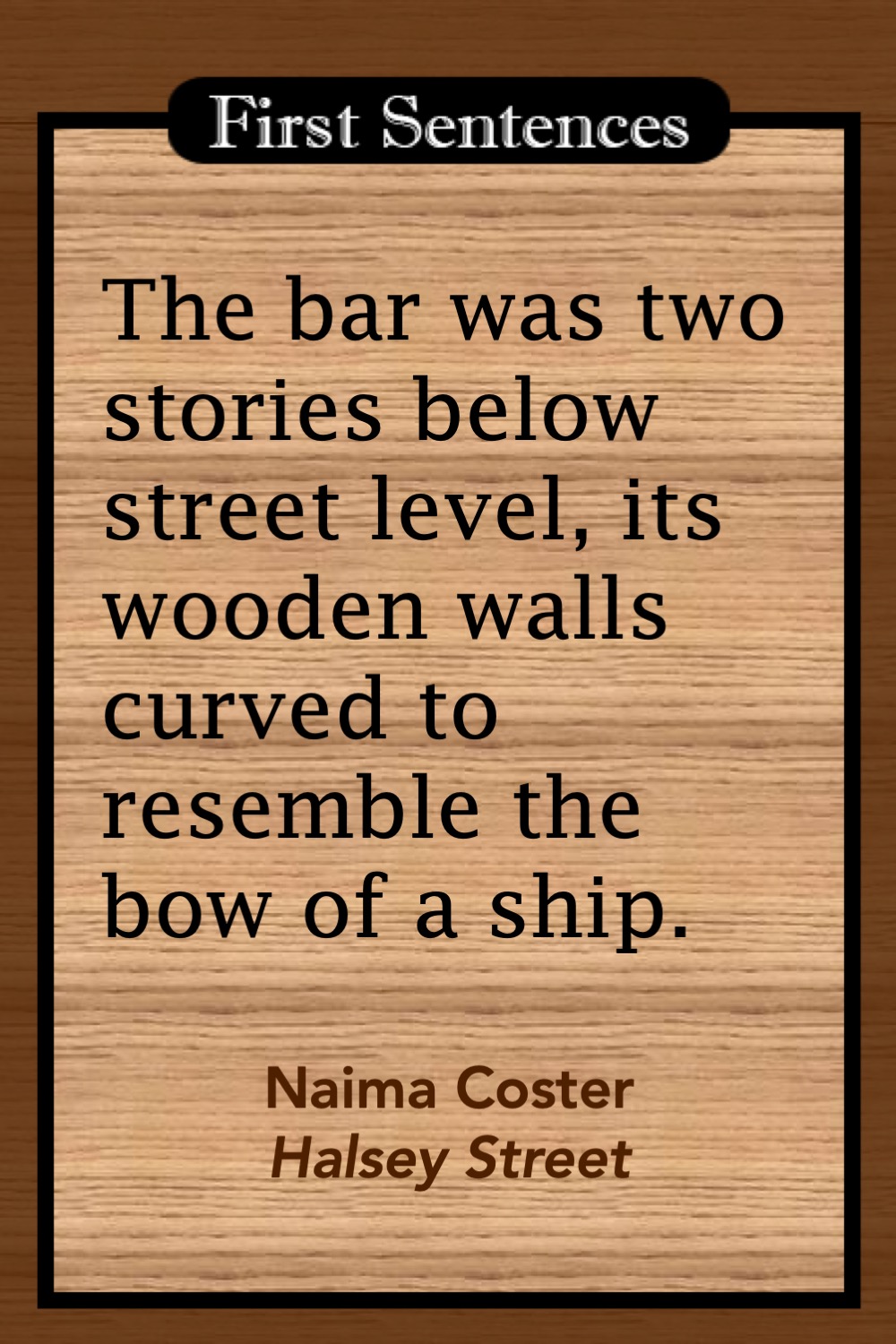
Naima Coster's first sentence is pure description: "The bar was two stories below street level, its wooden walls curved to resemble the bow of a ship." No person appears. There's no immediate conflict. Instead, we see specific, fresh details. This places the sentence directly in the literary tradition. 

Literary works often include beautiful writing and close attention to the details of the world. Here we have a bit of alliteration: repeated "st" in "stories below street" and repeated "w" in "wooden walls." The rhythm is uneven, with no pattern repeating enough to draw attention to itself. 

Many stories start in bars. I have never seen a bar just like this one. At two stories below street level, it is hard to find. It might be the kind of bar that mainly fills with regulars, as people walking by would have a hard time spotting it. The curved wooden walls are unusual and distinct. I imagine them as sheltering as they enclose the bar's customers. 

The sentence ends by comparing the bar's walls to the bow of a ship. The bow is the leading portion of a ship. A ship already connects to travel and journeys, and by mentioning the bow particularly, the author strengthens that reference. Coster could have written "the hull of a ship" – after all, the entire ship curves. "Bow" struck me as the strangest word in this sentence. It's a deliberate choice – and it gives extra weight to the idea of a journey – and the way both "bar" and "bow" start with "b" adds another link between them. 

A bar and a ship are both places where many stories begin. In bars, we mix with people who may bring new possibilities. Ships can take us to new lands. Those associations intrigue me. The sentence also promises observation and good language, to make the coming journey vivid and enjoyable. I want to see where we go next. 

Graphic elements by Ken Silbert

Hat tip to Doug Weathers, my in-house proofreader, who caught the third alliteration between "bar" and "bow." I'm very lucky. 


Monday, February 15, 2021

Black Angel


Short stories can be fertile ground for seeking interesting first sentences. When telling a tale in few words, the first sentence needs to carry a fuller portion of weight than in a novel. I found several appealing first sentences in the anthology Octavia's Brood, and I recommend it to sample a variety of authors and approaches.

Walidah Imarisha's story, "Black Angel," starts with this sentence: "Under flickering streetlights, A. walked alone for the first time since she saved Tamee." I immediately imagined an urban, slightly dilapidated neighborhood, and then I wondered why. "Flickering streetlights" is a telling detail. Cities have streetlights, and they flicker either as the sun sets or when they are in bad repair. The words "alone" and "saved" both suggest danger, a better match to the lights being out of order than to sunset. Finally, the -ing ending of "flickering" shows that the on and off lighting continues over time, while "A. walked." Sunset flickers are brief. The precise detail of flickering streetlights was enough for my mind to conjure an entire city street. 

The sentence gives us two important clues about when it happens, as well. It's night, since the streetlights are on. This is also the first time in a while that A. has walked alone. Every first time marks a change. A.'s new activity exposes her to new dangers. A dark street in the city is hazardous, especially alone. That creates tension. 

We also have two characters: A. and Tamee. Normally, a woman would be more at risk alone, but A. saved Tamee. She must be strong. Is she ready to handle this street, at night, alone? The sentence implies that question, and seeing how it plays out carries us into the story. 

Some first sentences unroll a thread that runs through the entire story. This is one of them. I liked the sentence and the story. 

Graphic design by Ken Silbert


Monday, February 08, 2021

A Prince on Paper


Suppose you wanted to pack your first sentence with as many story elements as possible. The first sentence of Alyssa Cole's book, A Prince on Paper, is an excellent model to follow. 

Cole starts her sentence with a name: Nya Jerami. Both the first name and the last name fall outside the naming traditions I've seen the most of. That suggests Nya Jerami comes from a different world or culture. By starting with a name, Cole places that person at the center of her story. 

Next, we see Nya take action: "returned her ... seat ... pushed aside her braids." She controls her situation, in at least these small ways. A character who acts is more appealing than one who passively suffers from outside forces. 

The trappings of these actions begin to outline Nya's world. Her seat is "obscenely comfortable," suggesting great wealth. She has "wireless earplugs," suggesting modern technology. "Seat to the upright position" is a phrase belonging to airplane travel. Nya is traveling in style. 

Notice how the punctuation makes this sentence easier to read. The comma separates Nya's two actions, and with "then" clearly shows that Nya completes one action before starting the next. The dash makes a more emphasized break in the sentence. After the dash, Nya is no longer acting – we are seeing the reason for her actions: "no amount of relaxing meditation music was going to make her feel better" so there is no reason for her to leave the ear plugs in to continue listening. 

The very last phrase shows what she is stressed about "returning home to Thesolo." This shows the conflict. Home is often a place of comfort, but Nya feels bad about going there. Where is Thesolo? The specific technology of our world – reclining seats and wireless earplugs – meet the name of a place that doesn't exist in our world. We are in a slightly different world, with elements of fantasy – great wealth and an unknown place – beside elements of reality. 

The strong, final word both shows us that this is an alternate reality and completes the sentence's description of Nya. She is a woman with braids from Thesolo. 

The sentence contains character, world, and conflict, action, feeling, and description. 

Cole could have broken it into three sentences: "Nya Jerami returned her obscenely comfortable seat to the upright position," "She pushed aside her braids to remove the wireless earplugs from her ears," and "No amount of relaxing meditation music was going to make her feel better about returning home to Thesolo." That would have felt like these three concepts were less tightly tied together, and it would also have slowed the readers' arrival at the conflict, as we pause longer at periods than we do at commas or dashes. If the first sentence stops at "upright position," Nya has fewer dimensions. We've only seen her comfort at that point – not her braids, her home, or her sadness. 

The choice to combine those three sentences works here, and Cole's punctuation supports that choice beautifully. The rhythm of the sentence, with mostly one or two unstressed syllables between stressed syllables, also makes the long sentence easier on the ear. 

I have extra admiration for sentences that open a story well in few words. To use this greater number of words, and keep the sentence clear and smooth, and capture this many story elements, is also good writing. 

Graphic elements by Ken Silbert

Monday, February 01, 2021

Milk in My Coffee


I heard of Eric Jerome Dickey's death last month and went looking for one of his books. Milk in My Coffee caught my eye. I liked the first sentence, and I liked the book. I wish I'd heard of him sooner. 

"Before I could make it to the 42nd Street station in Times Square, my damn fingertips were aching." The sentence establishes a specific location: near 42nd Street station in Times square. We could find this place down to the block, and from New Year's Eve broadcasts and dozens of movies, we know this place: New York City. 

We also hear a voice. The mild swear word "damn" intensifies the final phrase and marks the speaker as someone who will break a social expectation. It makes the sentence rougher, bolder, and more personal. It falls in a curious place: "my damn fingertips were aching." It's more common to swear at other people or outside circumstances. Who would damn themselves or some part of themselves? Why be angry with your own fingertips? 

The fingertips hurt. They started hurting "before I could make it" – that is, in a short time. It must be very cold outside. 

So we have a character ("I," a person open enough to swear in front of us), in a location (Times Square), with a problem (very cold). That's three strong parts of a setting. 

The physical cold won't last. But swearing at oneself is a sign of discomfort – perhaps an emotional sort of cold – that could take longer to overcome. Now the story is well launched. 

I'm not sure why Eric Jerome Dickey hadn't come to my attention sooner. The ways I keep up with publishing hadn't intersected his publicity. I'm spreading my attention more widely since I started gathering interesting first sentences. I was glad to have his portrait of the people and perspectives in Milk in My Coffee. 

Graphic design by Ken Silbert

Monday, January 25, 2021

The Nickel Boys


First sentences are like icebergs: Only a fraction of their meaning lies on the surface. Every word reflects the ways people use it, the places we've seen or heard it used before, the world that we describe with it. The first sentence of Colson Whitehead's book, The Nickel Boys, is the forty-third one I've written about. The underlayments and reflections of first sentences let me continue playing and discovering. 

"Even in death the boys were trouble" is another short, potent sentence – seven words. The word "death" always raises the stakes. All our survival instincts rise when we fear the cutoff of life. 

"Boys" raises the stakes again. It's worse when the young die. We hope every life will be a long one. There is not one dead boy, either – the sentence says "boys," not "boy." Many years of potential life have been lost. When the words "boys" and "death" come together, something has gone very wrong. 

The words "boys" and "trouble" can come together for situations that are light as well as heavy. We have one vision of boys' trouble that is relatively harmless: taking frogs from the creek, hiding comics under the bed, sneaking an extra cookie. We have another vision that is dire: standing watch for drug deals, bringing guns to school, battling with fists and knives. These are our social stories of the trouble boys get into. Who do you see when you call up movies of these playful or threatening scenes of boys' trouble? How do the boys look different? School studies have shown that students tend to meet the expectations their teachers have for them. What a burden it must be to look like a boy we imagine for the worse scenes of boys' trouble. 

While death is the end of our hopes, it is also the end of our responsibilities. The narrator of this sentence still blames the boys for the trouble: "Even in death the boys were trouble." How can this be? What continuing action can the boys take that will bother the speaker? They can't. By saying this, the narrator pushes their own responsibility onto the boys, making the boys the scapegoat for trouble the speaker has brought upon themself. 

(I would put a comma after "death" in this sentence. I strongly prefer to end opening phrases that place the rest of the sentence in a time, place, or situation with a comma. Good writers can disagree on punctuation choices.) 

This first sentence sets the tension for the story very high. It also shows the work of prejudice, as the narrator blames the boys, even beyond death, for trouble. 

That's a lot to accomplish in a handful of words. The many links we have from these words – especially "death," "boys," and "trouble" – to our own experiences make that impact possible. 

Graphic elements by Ken Silbert

Monday, January 18, 2021

The Lincoln Lawyer


At Goodreads, Michael Connelly put up a note about how he found the first line of his book, The Lincoln Lawyer. That gives us an opportunity to see behind the curtain. Before we look at what the author said, let's look at what the sentence says.

The first line is: "There is no client as scary as an innocent man." There is no location, no time, and no name in this sentence. Instead of describing a particular moment or person, this sentence asserts a conclusion. From some experience or observation, whoever is speaking believes something about clients, fear, and innocence. 

Who has clients who might be innocent? Most likely, a lawyer does. Who is afraid when they are? Again, a lawyer. The narrator worries the most when their clients are innocent. 

That's a bit of a surprise. We expect that someone innocent is safe and well-behaved; a guilty client could be murderous or violent or scheming. Why does the narrator think innocent clients are scary? That creates a mystery that draws us to read on. 

The words doing most of the work here are client, scary, and innocent. Those three are the most distinct, and the last two set up the mystery. Will we see an innocent and scary client in the rest of the story? 

Michael Connelly heard this line from a lawyer and knew it was his first line and also the thru-line. Connelly wrote that he had been "searching the whole time for the thru-line, the engine of the story." Once he heard this, he "started putting together a story that would prove what the lawyer had told me." Because he had been planning to write a novel about a lawyer, he was spending time with lawyers, and he was ready to catch the line when it came. 

I like the image of a sentence as an engine. When that happens, the first sentence captures the essence of the story. This one promises that we will see an innocent man in a scary situation. It's a strong start to a good story. 

Monday, January 11, 2021

Fabulous Beasts


The first sentence of Priya Sharma's story "Fabulous Beasts" is another short, potent sentence. It's a piece of dialogue. Someone – we don't yet know who – is saying, "Eliza, tell me your secret." That quickly, we have two characters: Eliza and the person who is speaking. 

The speaker knows Eliza well enough to address her by her first name. That could be close knowledge or casual knowledge, depending on the setting. In some worlds, only the very closest of relationships allow the use of a first name; in others, the first name is the usual introduction at a party or bar. The speaker also knows enough of Eliza to believe Eliza has a secret. And the speaker has standing enough to command that Eliza share the secret. 

We now know Eliza's name and that she may have a secret as well.

Secret is a strong word, and gains more strength in its position as the last word of the sentence. It means something is hidden – and "tell me" shows that someone wants to know it. That creates tension. We'd like to know the secret. What is it? Will Eliza tell? Why does the speaker want to know? 

If knowledge is power, then Eliza's secret is her power, and the speaker is hoping to gain it. There is a conflict there – if Eliza wanted it known, it would not be a secret. Eliza and the speaker want different results. 

In what situations do we hear someone say, "Tell me your secret?" Some of them are low-stakes: How did you make these cookies come out so well? Where do you buy your shoes? Some of them are high-stakes: Where did you hide the gold? Who is the traitor? Some of them carry emotional weight: Who kissed you? How did you get that bruise? From this sentence, we don't yet know what the impact of Eliza's secret may be. But because it starts a story, we expect it will matter for that story. There's no reason to tell a tale that starts with a secret if the secret doesn't have an impact. By starting with the secret, Priya Sharma is suggesting that what it is and what it means is the center of the story – the secret has importance and consequence. As readers of many stories, we understand that.

A secret, like a dead body, pulls us into a mystery. This sentence is a hook. 

Graphic design by Ken Silbert